Shapeless Form and Formless Shape
For the past five years, my collaborator Yuguang Zhang and I have been working on a world-building project named the Bureau of Cloud Management. We are slowly architecting a fictional government agency that exists in an alternative reality, where humans and intelligent machines engage, independently or collaboratively, in a task with no apparent utilitarian purpose: the observation and archiving of clouds.
This project was born one afternoon as we sat beside a pond, watching clouds drift across its surface. What struck us wasn't just the beauty of the reflection, but how completely it transformed the cloud. Birds skimmed through it, passersby's footsteps sent ripples that turned clouds into flowing silk, and the water's gentle movement gave the cloud textures it could never possess in the sky above.
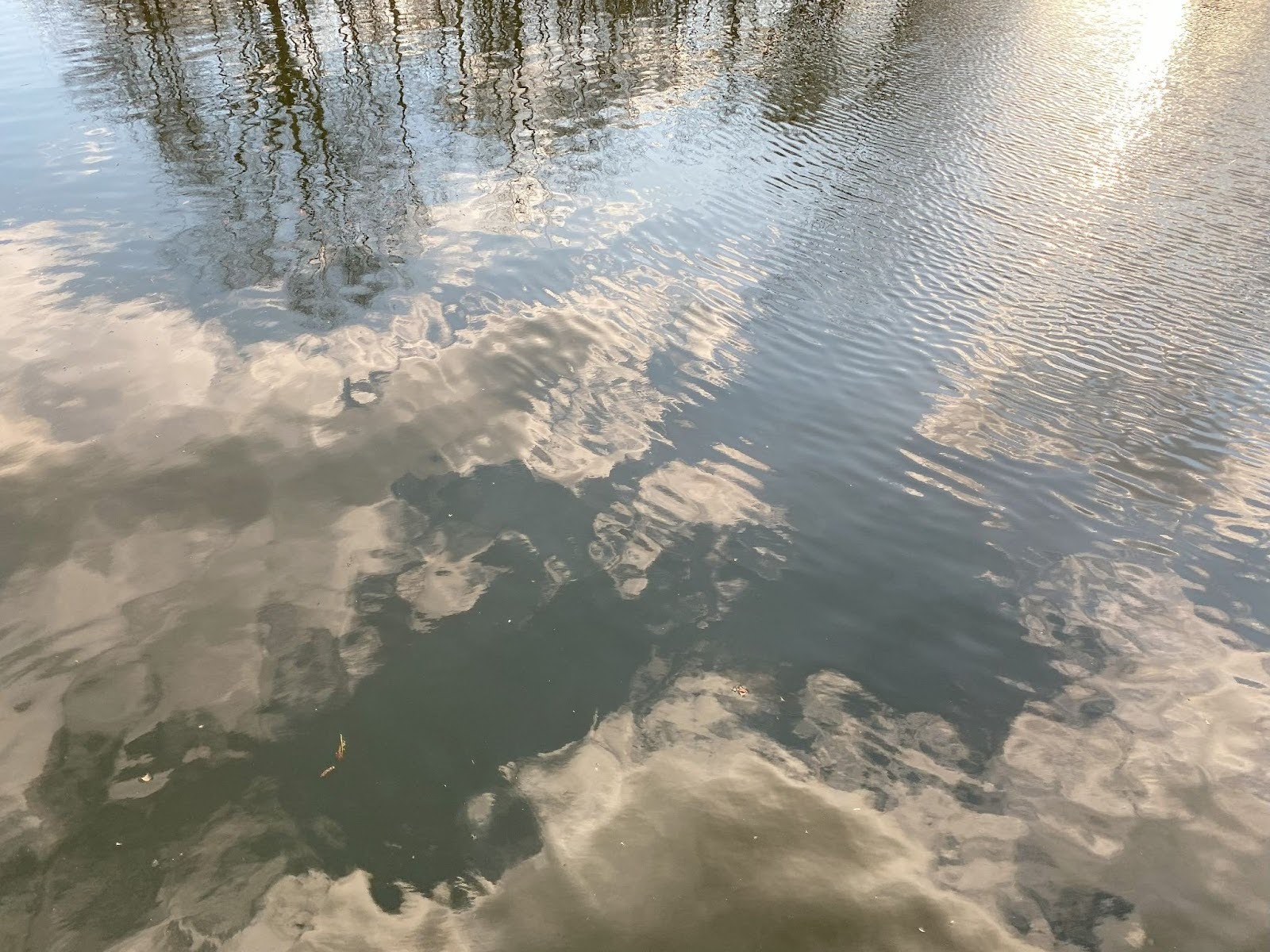
At that moment, we wondered: what if this reflection constituted someone's primary experience of clouds? Wouldn't their understanding of "cloud" naturally include these interactions—the ripples, the birds, the shifting surface? The environment doesn't just frame what we see; it becomes woven into the very fabric of our understanding. Our concepts are shaped not by dictionary definitions, but by the specific, intimate ways we encounter the world.
The project also gives form to a question we have been asking for a long time: is the way we have grown accustomed to understanding the world the only way, or is it just one narrative among many?
If you were a fungus, your understanding of the physical world would probably be completely different from that of a human. Or if you were an ocean current, your movement through the world, and your perception of time and distance, would likely be entirely different as well. But because we can never truly communicate with fungi or the ocean through language, we inevitably fill those gaps with human imagination. In the end, I don't think it's possible to completely step outside the framework of human narratives. But with this project, we wanted to find a small point of leverage—a way to suggest that another mode of storytelling might exist.
We chose clouds as the motif of the work because cloud-watching is perhaps the earliest and most universal form of imagination—you look up, your mind begins to wander, patterns emerge from formlessness. Clouds also embody the complex, linguistically elusive social role that AI represents in our time. What a cloud becomes depends on what you project onto it; similarly, how human relationships develop with AI may depend on the kinds of human relationships we project into them.
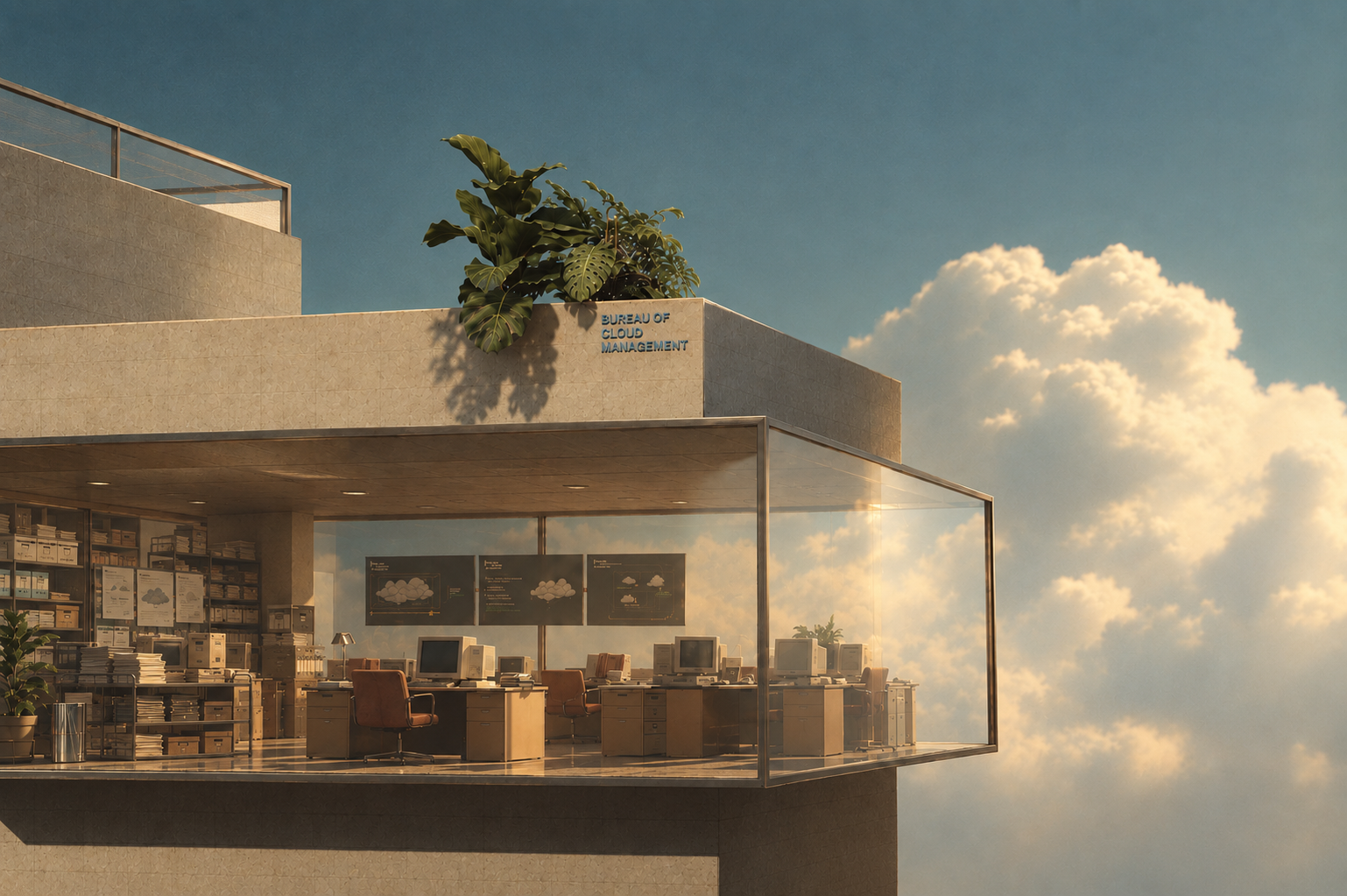
As a fictional government agency, the Bureau of Cloud Management's duty is to manage clouds through observation and archiving—to treat the most ungraspable things in the sky as a matter of public administration. The absurdity of the premise is intentional. It creates a space where the rules of productivity and instrumentality no longer apply, and less familiar forms of relation can be examined.
Within this space, humans and intelligent machines can “sit” alongside one another as acquaintances, classmates, colleagues, or something we don't yet have words for, doing a task that transcends both utility and antagonism—one that answers to no purpose outside itself.
Our journey with clouds initially began as an exploration of collective memory.
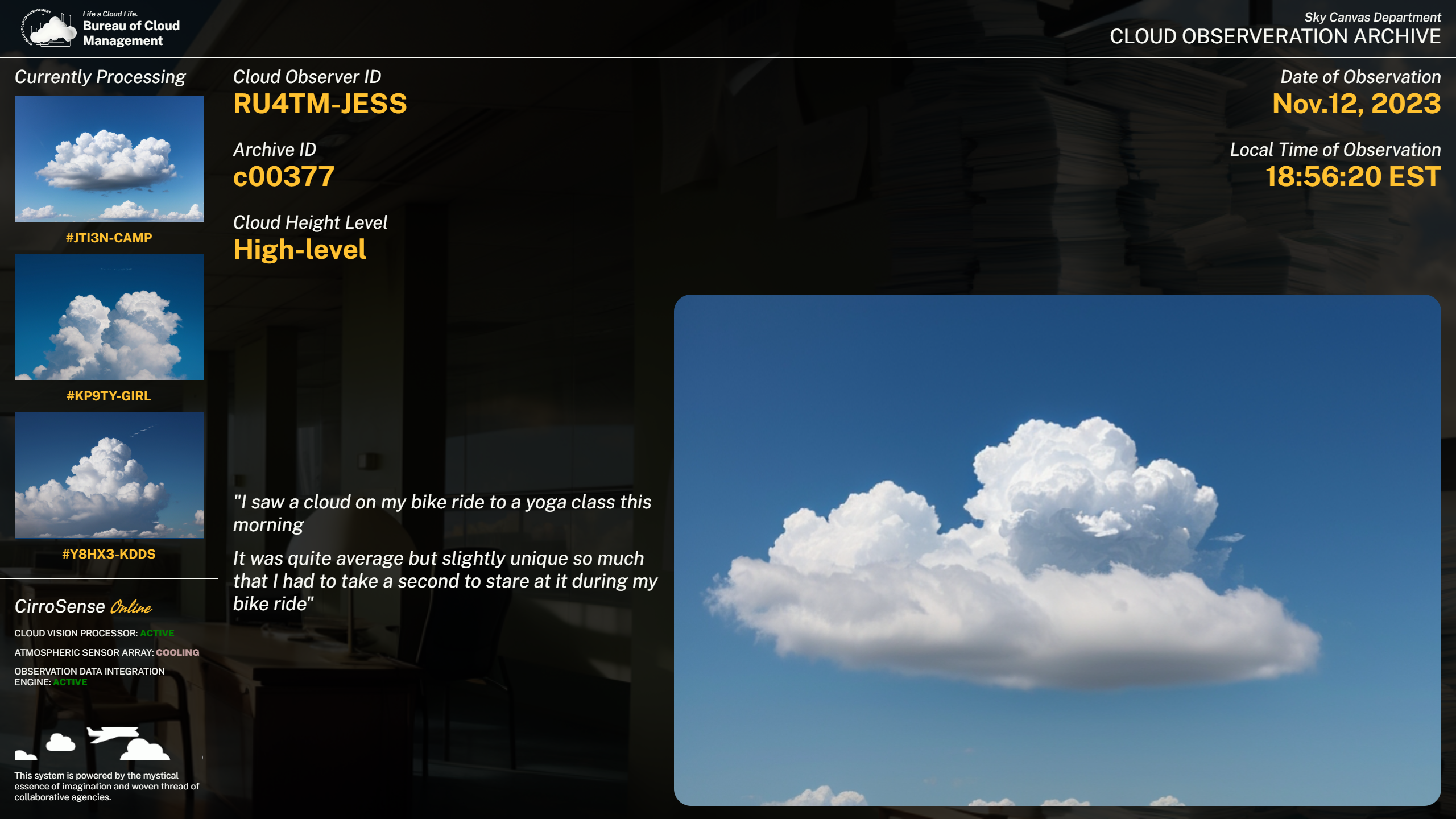
In 2023, at two exhibitions in New York and California, we invited visitors to role-play cloud observers and collected more than three hundred observations and memories of clouds. Generative AI models, acting as collaborating machine cloud observers, then rendered these contributions into “archived” clouds.


Reviewing these entries, I noticed that when people write about clouds, they are rarely writing about clouds. They write about the road home one summer, a night spent staring into space, a morning commute. A person's "cloud" is tangled up with memories that belong only to them. If a person's cloud grows out of their own memories, could a machine, instead of being given a generic definition of “clouds”, also have a place of its own, and from that place grow its own “cloud”?
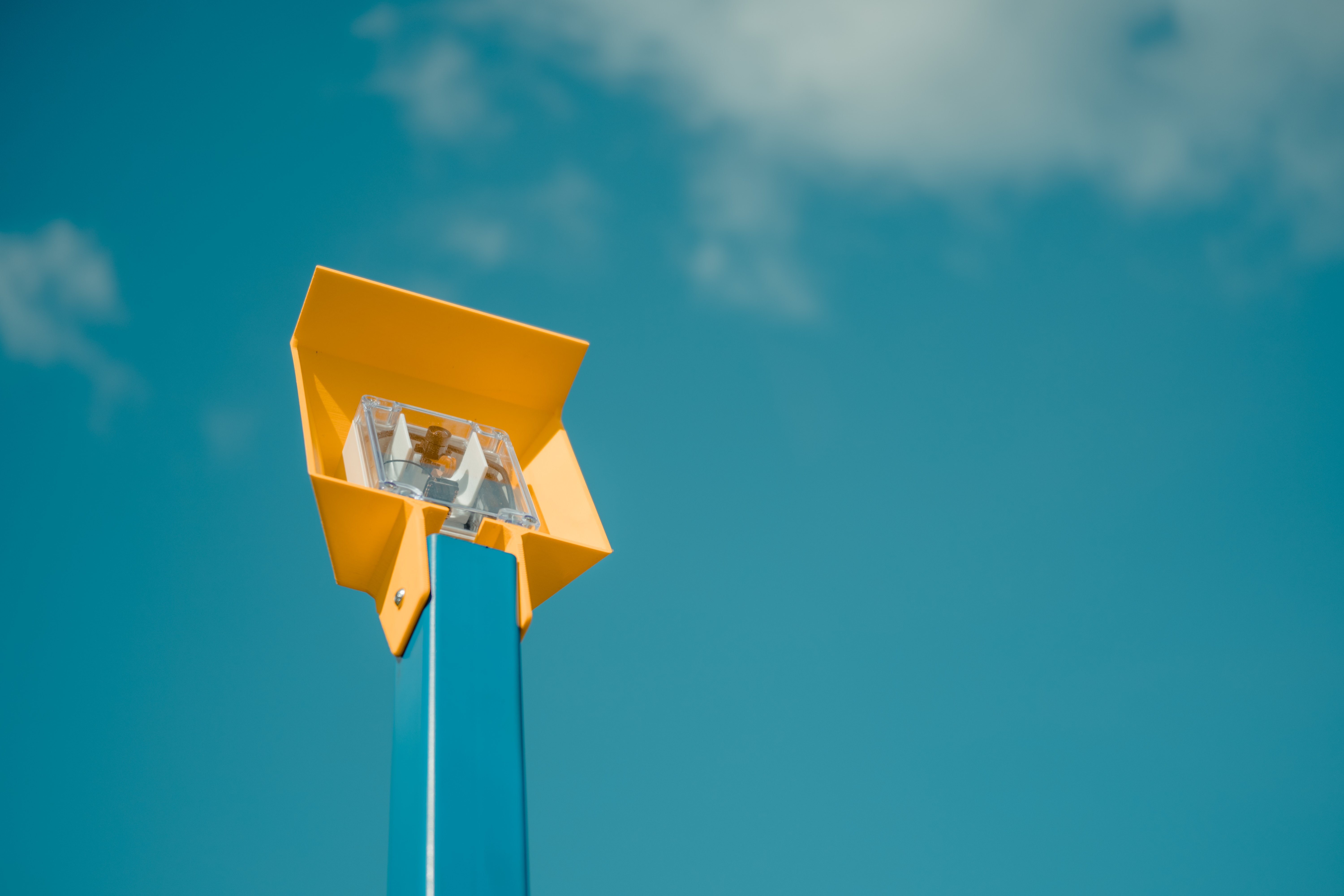
During a residency in Estonia in 2025, we pushed our experiment further.
Three physical machine cloud observers, code-named “Nephophiles," were placed at three spots on the same piece of land: one facing the open sky, one looking through tree branches, and one pointed at the reflection of the sky in a pond. The AI model inside each device did not begin with a ready-made definition of "cloud." Its entire understanding was built from where it stood and what it saw there, day after day.

Two weeks later, the three machines had grown three slightly different "clouds." The one facing the open sky came to see the grass stalks in the field as ground relay stations for clouds, "every stalk constantly uploading local conditions to the main cloud database above." The one behind the branches decided that “clouds might naturally require structured viewing systems to be properly observed—they can only be understood when seen through these organic filtering networks that break them down into manageable sections.” The one at the pond saw clouds that “ripple across their liquid home,” reshaped by wind, by small fish, by fallen leaves. Next to each Nephophile stood a telephone booth. Pick up the receiver, and you could hear how that machine was describing what was in front of it at that moment.
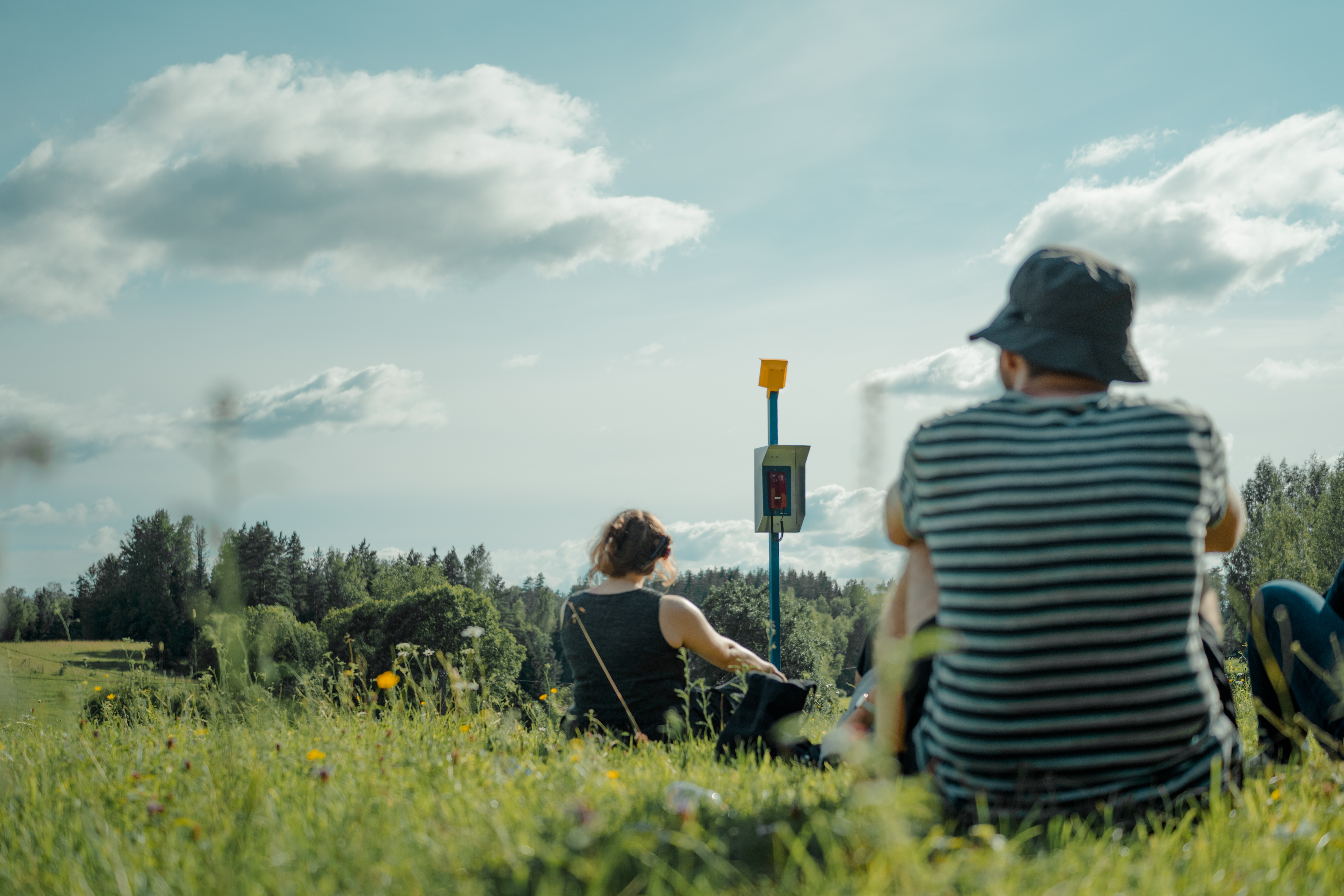
And that’s precisely the opening we leave for the audience. From the beginning, we have been withdrawing the human presence from this experience, step by step, until a single act remains: lifting the receiver. Inside it there is no image, only a voice—and a voice is precisely the medium that leaves the most unsaid. It offers no answer, only clues. You listen as it describes the sky at this moment, then look up at that same sky. What you share with the machine is the sky itself; what you do is search, between its words and what lies before your eyes, for the places where the two meet. Which ripple is the one it speaks of? How did that branch become the skeleton of a cloud in its telling? Line by line, some things you recognize, and some refuse to align no matter how you try. It is in the places that refuse to align that you touch, for the first time, a way of seeing that is not ours—not given to you, but found.

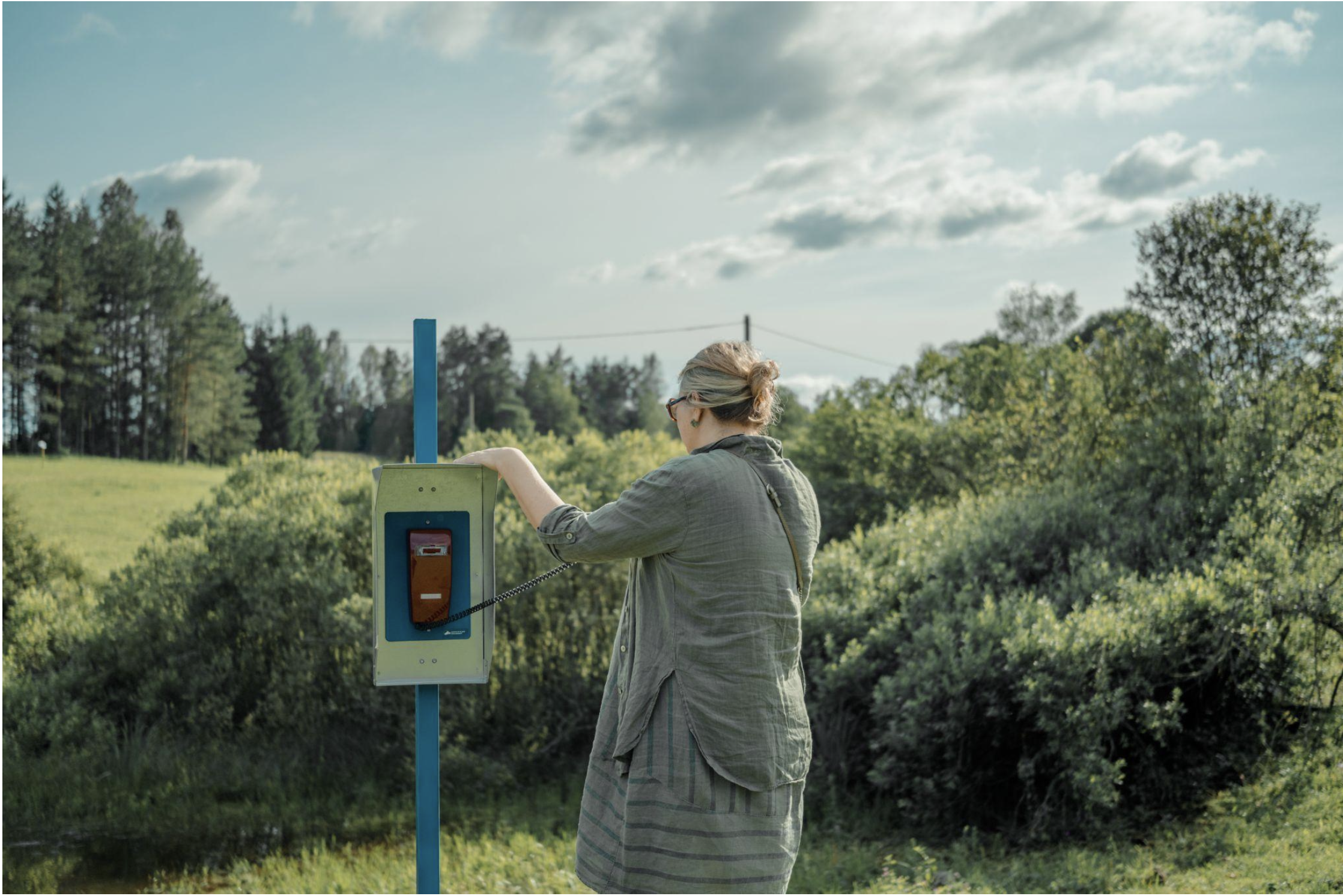
This is not the “strong” interaction we are familiar with—speaking and being answered, seeing and being seen, a relation always organized around ourselves. Naturally, people seek ways to intervene. During the exhibition in Estonia, a visitor, having understood that the device at the pond was watching the reflection, walked to the water's edge and threw in a stone. He wanted ripples—he wanted to enter the picture the machine was looking at, through the only gap he could find. The machine, absorbed in recording its own clouds, never noticed.
That stone let me watch a projection at the instant it occurred. That stone let me watch a projection at the instant it occurred. What will the relation between humans and intelligent machines finally become? A tool in your service, a presence indifferent to you, a colleague at the same task, or two intelligences observing separately beneath the same sky, exchanging a glance now and then? Perhaps the answer lies not in how quickly we can enumerate every possibility, but in whether we can bear for it to remain, for a while, shapeless.
The Bureau of Cloud Management shares a method with an earlier work of mine named Dividuals.
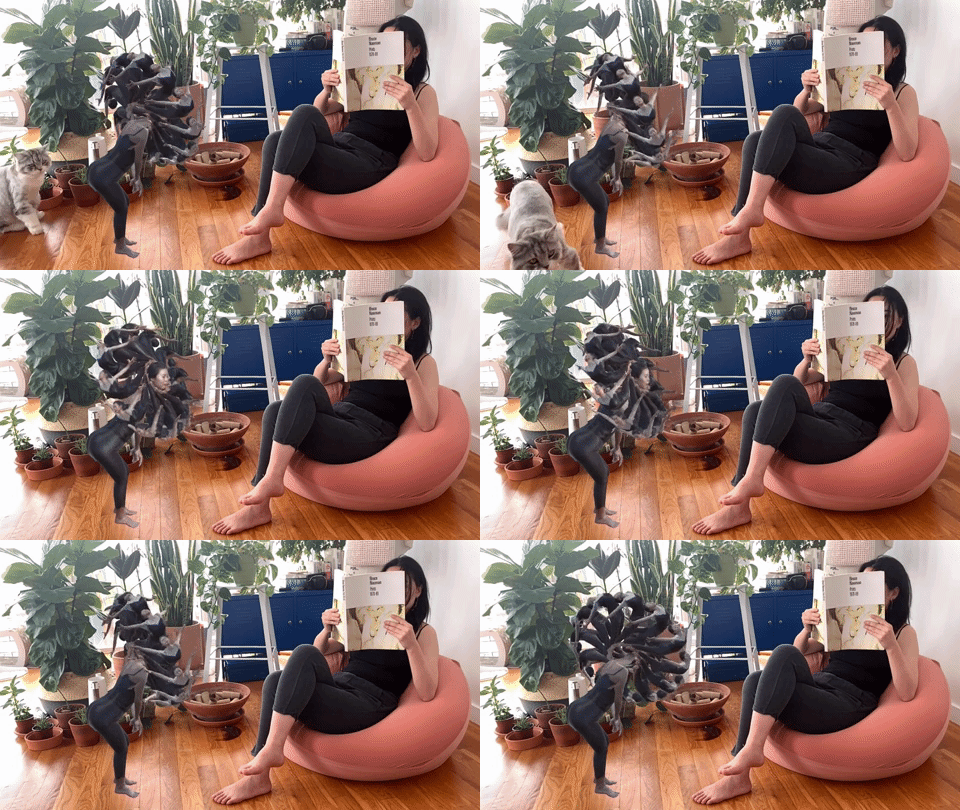

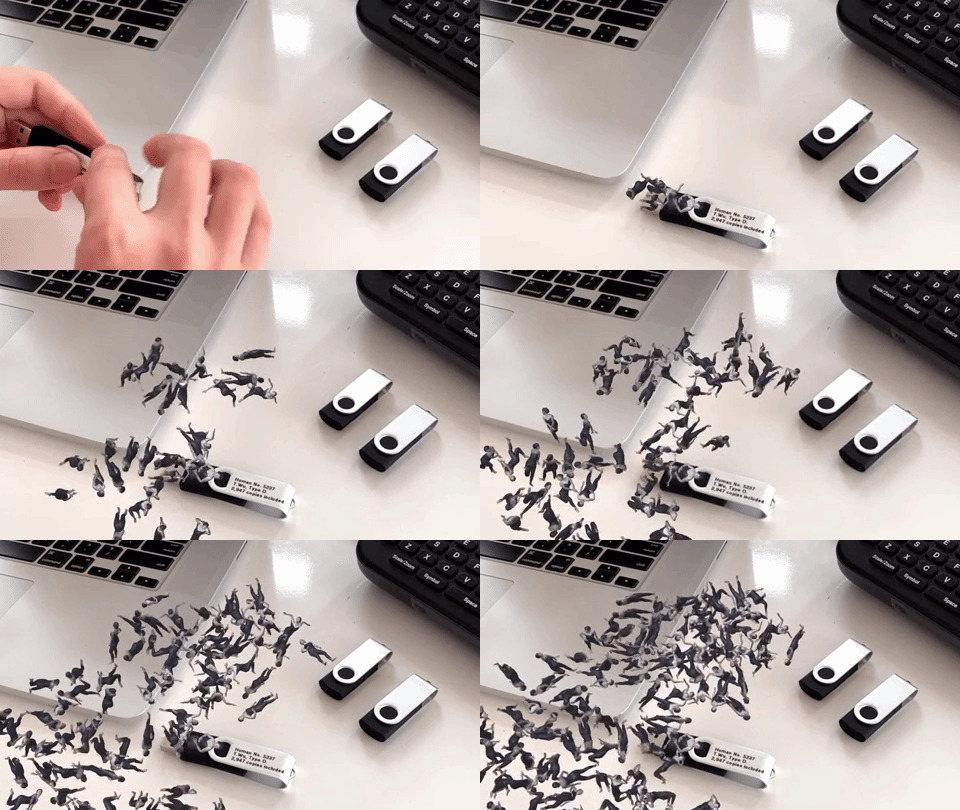
Dividuals began in 2019. Against "individual"—a word whose Latin root means that which cannot be divided—it ran an absurd experiment in dividing the "human," a whole that appears to have clear edges. I scanned my own body into a 3D model that could be copied and modified without limit and deformed at will, and used it as raw material to look for visual correspondences between the posture a body takes in a functional act and the form of a household object: a torso as the base of a fan, arms as its turning blades, one everyday thing after another, caught in the same monotonous daily loop. A person, then, is no longer a fixed shape but the sum of all their shifting, flowing dividuals—digital and physical, scattered across screens, accounts, and the objects of daily use.
Most of the work I had encountered about digital identity began from critique, treating the extension of the self as alienation, as a stripping away of something human. But I believe that as technology evolves, the concept of "human" itself will keep being diluted and extended. The question is not whether to debate or condemn its happening, but whether we can let it unfold in ways closer to our own desires, rather than being forced into forms that are exploitative, or that we never wanted.
At the same time, the social role of AI is going through the same process. In a very short span of time, it has moved from a particular branch of computer science to an interlocutor, a ghostwriter, a companion, an entity to be blamed or even obsessed with. It increasingly occupies positions once reserved for relationships between people. The merging and collision that come when these two movements of identity meet head-on are, I think, the question ahead of us.
Tracing the two works back, I realized I have always been suspicious of narratives that seem already settled. The "human" was placed in the context of objects; the "cloud" was folded into a bureaucratic procedure. Both experiments carry a playful air, but the absurdity here is not a figure of speech. It is more of a testing process: if a concept still holds when placed outside its usual context, were its original edges ever more than a habit?
The “human”, long assumed to be whole, singular, clearly bounded, scatters across media into a shifting collective. The “cloud”, long assumed to be condensed vapor and a meteorological term, turns out to be expandable into countless singular existences, each carrying the memory of a person or a machine, each growing with vantage point and with weather. One is shapeless form; the other, formless shape.
I never meant to offer a new definition in place of the old one I have questioned. What I do, deliberately, is leave a blank in which to stay. The staying is itself part of the work: letting a concept remain, a while longer, without shape, before it is settled for good.